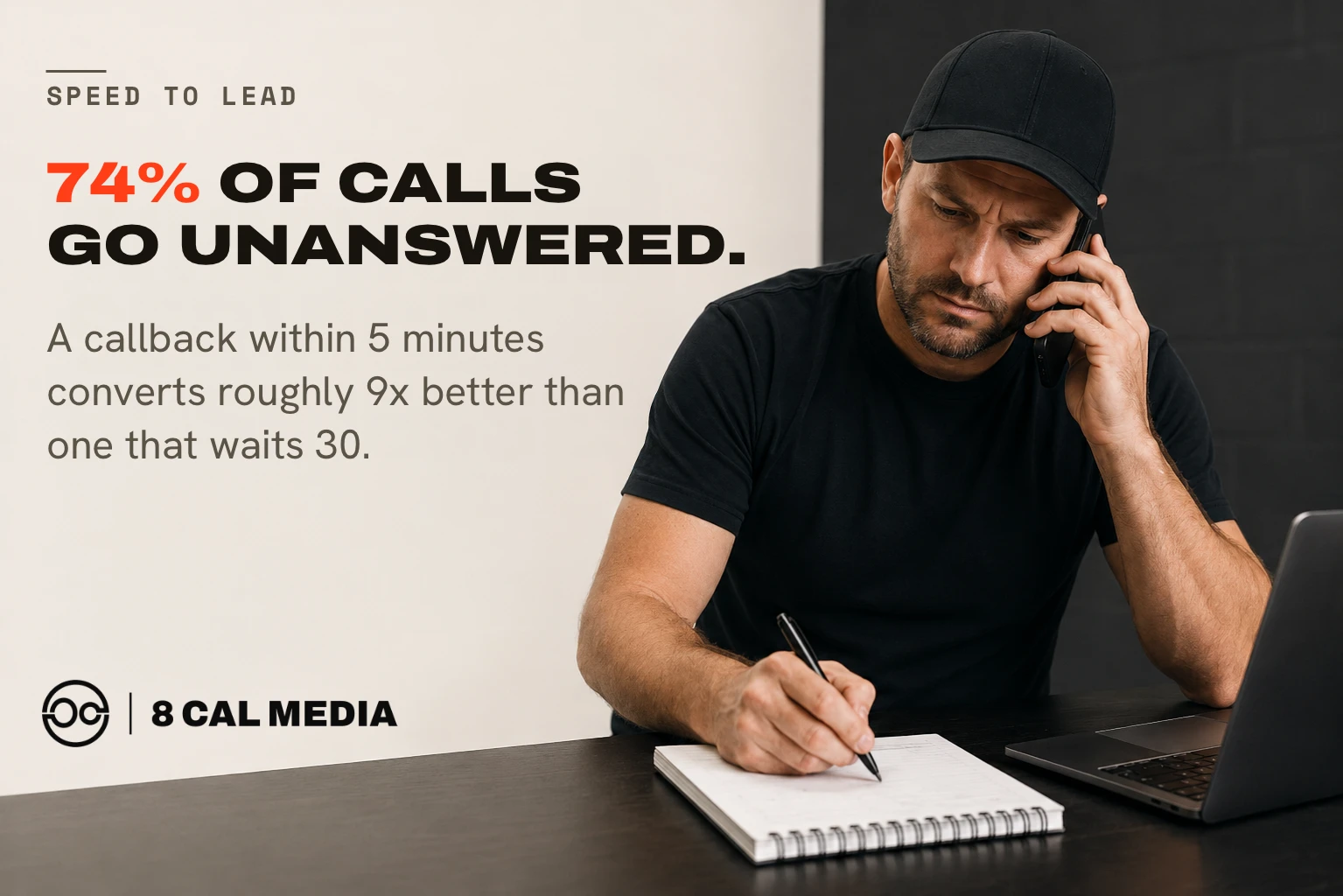
Home service businesses lose a large share of jobs to missed calls and slow callbacks, not bad marketing. About 74% of contractor calls go unanswered, and roughly 85% of callers who land in voicemail never call back at all. Leads contacted within 5 minutes are 21 times more likely to be qualified than leads contacted after 30 minutes. Fixing response speed is usually the fastest way to book more jobs without spending more on ads.
Every home service business owner has had this week. You're under a sink, or on a roof, or halfway through an install, and your phone buzzes. You can't get to it. You tell yourself you'll call back after the job.
Here's what actually happens next, most of the time: they don't wait for you. They call the next name on Google.
That's not a small leak in your business. That's the whole bucket.
Across the home service industry, roughly 74% of contractor calls go unanswered. That figure comes from a 2026 NextPhone analysis of 130,175 inbound calls across 45 contractors. That number holds up across HVAC, plumbing, electrical, roofing, and other trades, because the pattern is the same everywhere: owners and techs are on job sites, not sitting by a phone.
Of the people who don't get through, about 85% never call back at all, according to that same NextPhone analysis. They don't leave a voicemail and wait. They dial the next name on the list. Homeowners calling about a broken AC, a leaking pipe, or a cracked foundation aren't browsing. They have a problem right now and want it handled right now. That urgency is exactly why they won't wait around for a callback.
Speed matters more than almost anything else in the sales process. The Lead Response Management Study out of MIT, published in Harvard Business Review, found that leads contacted within 5 minutes are 21 times more likely to be qualified than leads contacted after 30 minutes. ServiceTitan's 2025 Home Services Benchmark Report puts numbers on what that means for the trades: contractors responding in about 2 minutes convert 62% of leads, against 28% at the 42-minute industry average. Five minutes is the number to build your process around, not same day, not "when I get a chance."
You can spend real money on ads, SEO, and a strong Google Business Profile, and still lose the job in the first five minutes because nobody picked up the phone. Marketing gets someone to reach out. What happens in the next five minutes decides whether that turns into revenue. This is also why review responses and Google Business Profile activity matter so much. Homeowners are checking both before they even call, and if two companies look equally credible, the one that responds first wins the job every time.
"Marketing gets the phone to ring. It doesn't matter how good the marketing is if the call isn't answered or returned fast."
You don't need a bigger marketing budget to fix this. You need a system.
Getting found is only half the job. Homeowners can find you through the best SEO and ads money can buy, but if the phone rings out or the callback takes an hour, none of that spend matters. Fixing speed to lead costs you attention and a system, not a marketing budget. For most home service businesses, it's the single fastest way to book more jobs without spending another dollar on advertising.
A marketing audit shows you your real answer rate, response time, and where leads are slipping through.
A marketing audit is a straight look at how many calls and leads your business is actually losing, and what it would take to fix it.
Book Your Call